
AI in Hiring, Artificial Intelligence, ATS, Candidate Experience, Candidate Qualification Screening, Change Management, Company Updates, Data Analytics & Reporting, Diversity, Equity, & Inclusion (DE&I), Hiring Assessments, Hiring Manager Engagement, Job Descriptions, Leadership, Managing Costs, Resumes, Talent Acquisition Problems
Talent acquisition teams have many priorities, and it’s hard to balance them all. What’s interesting is that many of the same priorities show up on the top initiatives list year-after-year.
If you are looking to make significant progress in any or all of these areas, then you need a solution that can PROVE they address all of these initiatives with practical examples.
With SmartRank:
Productivity – you could give your recruiters back 30% – 70% of their time back in their day
DE&I – you could have zero unconscious bias in your screening process
Hiring Manager Engagement – simply give them applicants that are EXACTLY what they want
Compliance & Legal – no bias data + 100% inclusive and objective screening = no calls from the EEOC and/or OFCCP
Data Analytics – remove assumption and opinion driven anecdotal conversations with data driven conversations
Applicant Experience – something actually new, different, better, and ultimately benefits the applicant
We can show how we specifically address each of these initiatives in less than 5 minutes each. If you are curious, schedule time with us to learn more (https://lnkd.in/gpyUcDF2)!

AI in Hiring, Artificial Intelligence, ATS, Candidate Qualification Screening, Change Management, Data Analytics & Reporting, Job Descriptions, Managing Costs, Resumes, Talent Acquisition Problems
Research and survey data consistently tell us that “reviewing & screening” applicants is the most time consuming task a recruiter has. The time spent on this task ranges anywhere between 30% – 70% per day. This is staggering and highly inefficient.
One has to immediately ask, what process on earth could create this level of inefficiency? The answer is easy when you look at how most recruiters review and screen applicants, manually and tediously. Opening each applicant in a traditional ATS one-by-one, matching keywords on a résumé to keywords on a job description is going to take a long time. What’s worse…it’s not very effective. It is definitely what most recruiters do, but it is definitely not efficient or effective.
What other manual and tedious tasks do recruiters have?
* Sending applicants to hiring managers and following up for feedback
* Following up on feedback after an interview
* Working through the rest of the applicants one-by-one, either inviting them to interviews, dispositioning, etc.
So the big question is really WHY do we do this? Short answer…because this is how we’ve always done it. These problems with recruiters never having enough time, which ultimately leads to burnout, are not going away until we stop doing it the same way we’ve always done it.
One last thing to consider. If your risk tolerance only allows you to try a “slight evolution” then it will likely produce a “slight improvement.” Maybe you go from 50% to 48.5% time spent on screening. Or you can look at a “revolution” which could take you from 50% to 5% of your time being spent on screening/reviewing applicants. It’s all about how motivated you are to solve that problem.

AI in Hiring, Artificial Intelligence, ATS, Candidate Qualification Screening, Change Management, Data Analytics & Reporting, Hiring Manager Engagement, Job Descriptions, Leadership, Managing Costs, Resumes, Talent Acquisition Problems
I was reading through a recent study named “Recruitment & Retention: Two Sides of the Same Coin” conducted by Aptitude Research which had some great data.
One data point in particular jumped out at me, “84% of recruiters…stated they do not have the tools they need to do their job well.” This statistic makes perfect sense. While the business world continues to change exponentially, HR and Talent Acquisition (TA) teams struggle to make the necessary changes to evolve at the same pace. Unfortunately these decisions impact everyone, not just the HR or TA teams.
This point above is specifically called out in the study and is probably the biggest challenge of all for HR and TA teams to overcome. The study states, “One reason that recruiters have not embraced this modern role is that they do not understand what it is or what they need to do. Most companies do not train, incentivize, or motivate recruiters to manage modern tasks. Yet, recruiters and recruiting departments tend to fall into the same patterns and routines, even when those routines are not bringing results.”
Sales doesn’t sell, marketing doesn’t market, and product development doesn’t develop the exact same way they did 25 years ago. If they did, their competition would crush them. I would even argue that business functions don’t do things the same way they did 5 years ago. And AI is changing the way we’ll be doing business 1-2 years from now.
If HR and TA leaders don’t immediately start breaking these patterns and routines in very significant and impactful ways (e.g., NOT introducing some new way of writing job descriptions), they will likely find themselves being replaced by people or technology that will.
As Leon C. Megginson once wrote in reference to Darwin’s Origin of Species, “It is not the most intellectual of the species that survives; it is not the strongest that survives; but the species that survives is the one that is able best to adapt and adjust to the changing environment in which it finds itself.” In maybe no other function of business is this quote more relevant right now than HR and TA.

ATS, Candidate Qualification Screening, Change Management, Hiring Assessments, Hiring Manager Engagement, Leadership, Managing Costs, Talent Acquisition Problems
“What in the hell is going on in recruiting” is the subtitle of a blog post put out by Visier. The actual title is “6 Reasons Recruiting Doesn’t Measure New Hire Failure Rates (But Should)” and calls out a very disturbing statistic that has been floating around for about a decade.
Think about it…what if your software only worked with 50% of the clicks. What if your product was only delivered to your customers 50% of the time. Would that be acceptable? Then why do we accept almost a 50% failure rate with new hires?
When you look up employee retention rates and turnover statistics you’ll find all kinds of data from various sources. A 2021 Bureau of Labor Statistics report found the overall turnover rate is 57.3%. Another study found that ⅓ of new employees quit after about 6 months.
Whichever statistic you want to pick, they all tell a similar story…turnover in the early stages is way higher than it should be. The only statistic that matters is what turnover percentage your company has, percentage for 0 – 18 month new hires, and the cost of that turnover. Not tracking that data is a mistake.
We all know there could be a million reasons why turnover is high. But who is to blame for these high turnover numbers? Talent acquisition will many times say it’s the hiring managers. Hiring managers will turn around and say it’s talent acquisition. They are both right, and they are both wrong, because it’s not one or the other, but rather the combined dysfunction that leads to high turnover.
So what can we do about it? Identifying the specific requirements of each role, backed by data, is one major step in the right direction.
We hire within the confines of a legacy system where we don’t identify these very specific requirements. We “think” we do, but we don’t. Instead, 90% of the applicants that get passed to hiring managers are based on keyword matching, and that ultimately contributes to the turnover problem. Hiring managers are then forced to pick the best of the 3 candidates they interviewed, based on the 20 résumés they reviewed. Does that mean those were the 20 most qualified applicants to look at? Most certainly not.
In the same Visier blog post, it mentions that “a majority of managers believe that less than half of all candidates that they interviewed were qualified.” Does this data support the problem mentioned in the paragraph above? Absolutely.
If companies have a turnover problem, they should start by digging into the beginning of the process and understanding how candidates are selected for interviews.
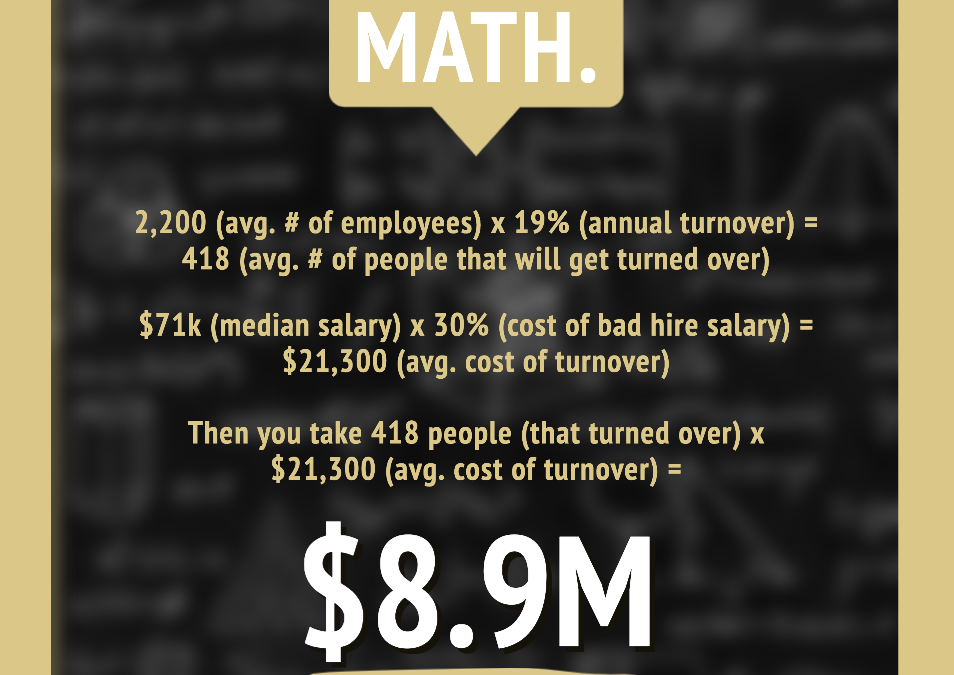
Managing Costs
No one wants to make a bad hire.
But nearly 3 out of 4 employers say they’ve hired the wrong person. Yikes.
It is no secret that bad hires are expensive. So… why is it so pervasive? Why is everyone still making bad hires?
Just hire better people, simple right?
Not so simple, it turns out. While it is a complicated issue, the answer likely lies in your hiring process. Putting in the work to improve here will benefit your culture and your bottomline. People are your most important asset.
The goal should be to be super selective and quickly identify the best candidates.
Your recruiters are not mind readers. Hiring managers need to know exactly what they’re looking for instead of relying on a job description that is likely outdated or just not specific enough.
Solution?
Try using SmartRank.
✅ 100% of applicants are screened
✅ Applicants are stack-ranked to show you top talent for your specific hiring manager and role
✅ No resumes = no subjective interpretation of skills or qualifications


